2025 October 7–25. This is my second visit to Asia since my first visit in 2018, almost exactly seven years since that first trip. This time the itinerary consited of a layover in Hong Kong, a few days in Georgetown, Penang (Malaysia), a few days in Singapore, and a week in Taiwan.
This trip was particularly interesting in that we visited some of the largest Chinese populations outside of mainland China. It presented an opportunity to learn about the conditions of each of these diasporas, at least at a very (very) surface level. I’m sure the summaries I’ll provide here are going to partially inaccurate due to having an imperfect lens—still, here are the views of an outsider.
Hong Kong
香港hoeng1gong2 (hoeng1gong2)
A short 10 hour stay is hardly enough time to get to know a city. Entering the city, I had only imagined it as a city of neon, of what was captured in the films of the 1980s and 1990s I had watched. Hong Kong is far more lush and mountainous than I had imagined, with natural beauty to complement the metropolitan city.
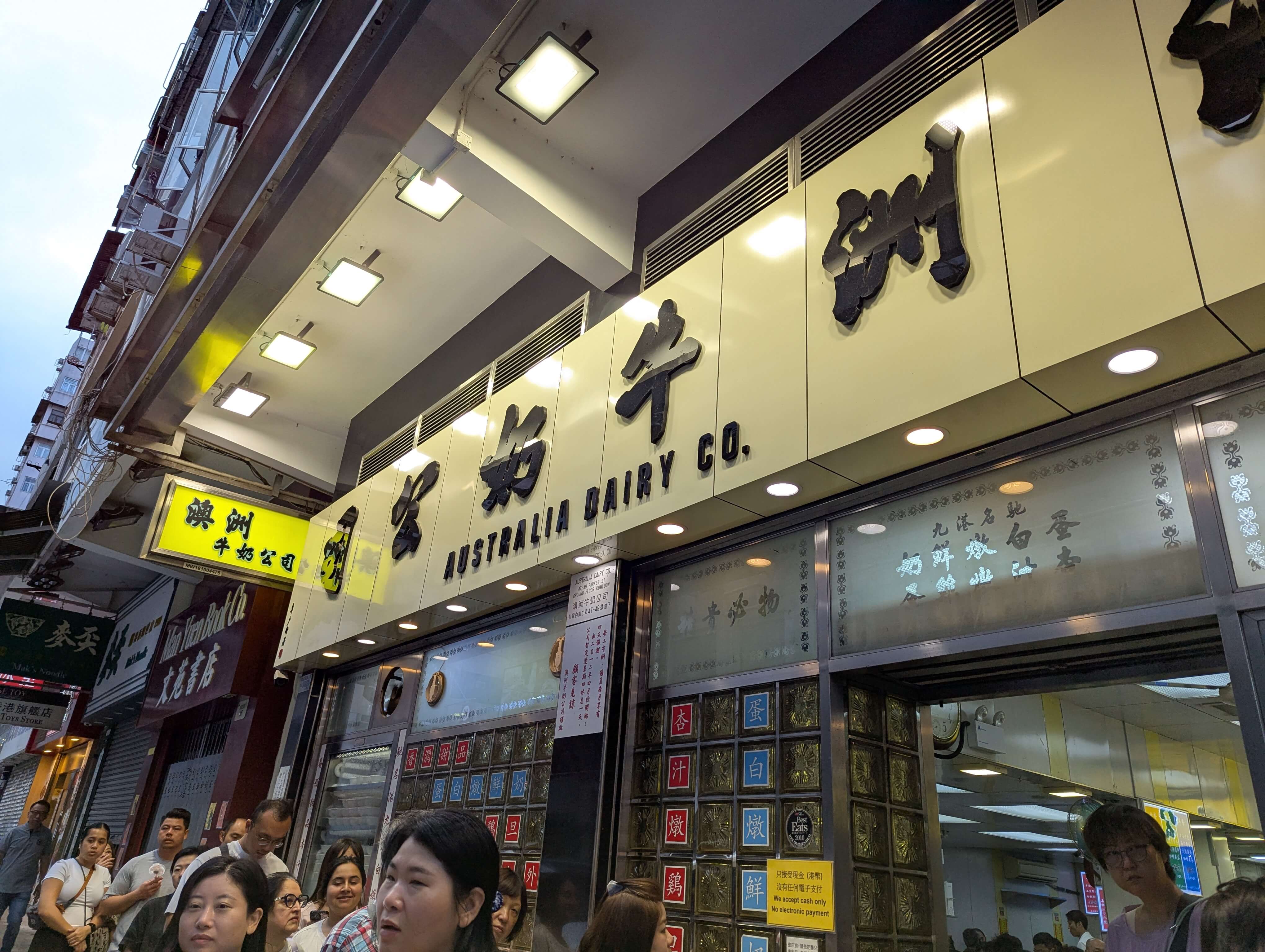
We stopped by at the Australia Dairy Company for a 茶餐廳caa4 caan1teng1 breakfast, something of a culture that I feel is harder to find these days in Canada. We also stopped for a bolo bau and some Hainanese chicken (which was probably the best one we had on the trip) as well during our stay.
While many of my friends grew up with Hong Kong as an adopted place for their roots, listening to Canto-Pop, HK cinema, watching TVB, I’ve always felt adjacent to it, that I hadn’t adopted it as the story of my roots. Despite that as a heritage Cantonese speaker, the continued success of Hong Kong feels inextricably tied to having a cultural safe harbour. There are real threats to Cantonese, in a way that mirrors the fate of other “dialects” in Malaysia, Singapore, and Taiwan, as well as Shanghainese in Shanghai.
I would love to come back again soon and spend more time here. It was a really enriching experience to be in a city where you can understand the language and appreciate the culture, that is not English. I’ll see you again soon Hong Kong!
Georgetown, Penang, Malaysia
檳城bīnchéng | ban1sing4 (bīnchéng | ban1sing4), 馬來西亞mǎláixīyà | maa5loi4sai1aa3 (mǎláixīyà | maa5loi4sai1aa3)
With a name like Georgetown, you know that there are colonial roots to the city. Georgetown was a key location of trade in the time of the British Empire and part of a collection of key settlements along the straight of Malacca. Having not known much about the history of Malaysia aside from a few conversations with a friend from there and “Queer as Punk,” a documentary about trans resistance, I realised I know very little about the country and the city. The country is about ~70% ethnic Malay / adjacent, ~20% ethnic Chinese, ~8% ethnic Indian with a national policy of multiculturalism, but also a policy of Malay supremacy. Malays are considered “born” Muslim with no way to renounce their religion.
Despite that, the city of Georgetown consists of a plurality of ethnic Chinese (42% Chinese - 41% Malay), as is not uncommon in the urban areas of the country. The historic Chinese populations control a disproportionate share of the economic wealth of the country, which also contributes to some of the politic challenges of the country. Peranakans峇峇娘惹 | Bābā-niángrě | Hokkien: Bā-bā-nō͘-niâ are a specific culture amongst descendants of Chinese settlers from the 1300s - 1800s, while more recent settlers typically trace roots back to Hakka, Hokkien, and Teochew migration.
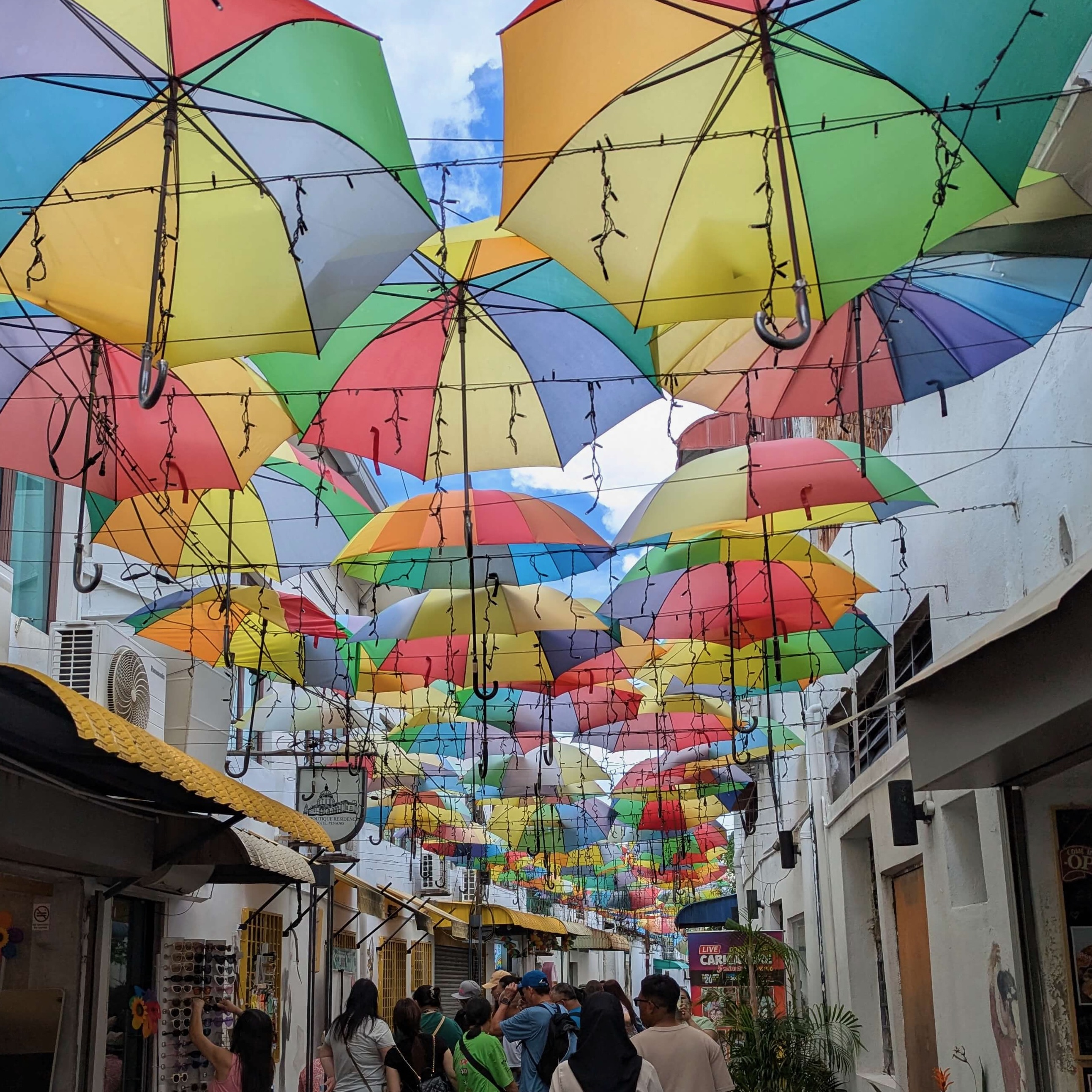
We didn’t spend too much time exploring the city as we were here for a wedding, but I was charmed by it. There definitely felt like a mix of cultures within the city with a storied history I only grazed the surface of. I would say the city was quite English friendly overall, and as such hard to tell when Cantonese / Mandarin would be more appropriate to use. My only Cantonese experience was our Grab driver back to the airport who was listening to Cantonese radio and had his navigation set to Cantonese. Another experience at a char kway teow炒粿條 | chǎo guǒ tiáo | Hokkien: chhá-kóe-tiâu | Cantonese alt.: 炒貴刁 caau2 gwai3 diu1 hawker which one of our party members managed to order in Mandarin (tasty but one of the most difficult ordering experiences we had).
Singapore
新加坡xīnjiāpō (xīnjiāpō) | Cantonese informal: 星加坡sing1gaa3bo1 (sing1gaa3bo1)
Our next stop was Singapore, a small country but an economic powerhouse in Southeast Asia (and the world). Singapore, as another former “jewel” of the British Empire, takes it even one step further with English being the defacto lingua franca of the city and one of its four recognised languages (among the national language Malay, Mandarin Chinese, and Tamil). Singapore, like Malaysia, has a policy of multi-culturalism, but flips the hierarchy with an ethnic Chinese majority. You’ll find stark generational divides with many of the older folks (e.g. those manning the hawker stands) not speaking english and speaking primarily in their own mother tongues.
Singapore and Malaysia have a very close relationship and a long history within the Malaysian peninsula, though charting slightly different paths. Lee Kuan Yew, the first Prime Minister of Singapore, is someone who seems to embody Singapore. A Peranakan, Lee was proficient in Malay, Hokkien, and his “master” language English, as well as passable Mandarin and at one time Japanese. He helped grow Singapore into the economic powerhouse it is today.
Singapore has been ruled by a single party for its 60 year existence, a fact that can often give one pause. Nominally a democracy, some have likened Singapore to as close an example of a “benevolent dictatorship” you might find. This is a country that bans gum as public nuisance, that only allows pre-approved protests, that is quite restrictive from a “Western” perspective. But it’s also a country that has achieved brought about economic prosperity for many (where we must also acknowledge the extreme class stratification and inequality). This is a country where gay marriage is not legal, but being gay is not criminalised. A country which requires its citizens to learn a second language. A country where Mandarin was adopted as the national language for Chinese Singaporeans and Hokkien, Hakka, and Teochew were suppressed. There are many things about of Singapore that I strongly disagree with, but also much that I feel enviable for.
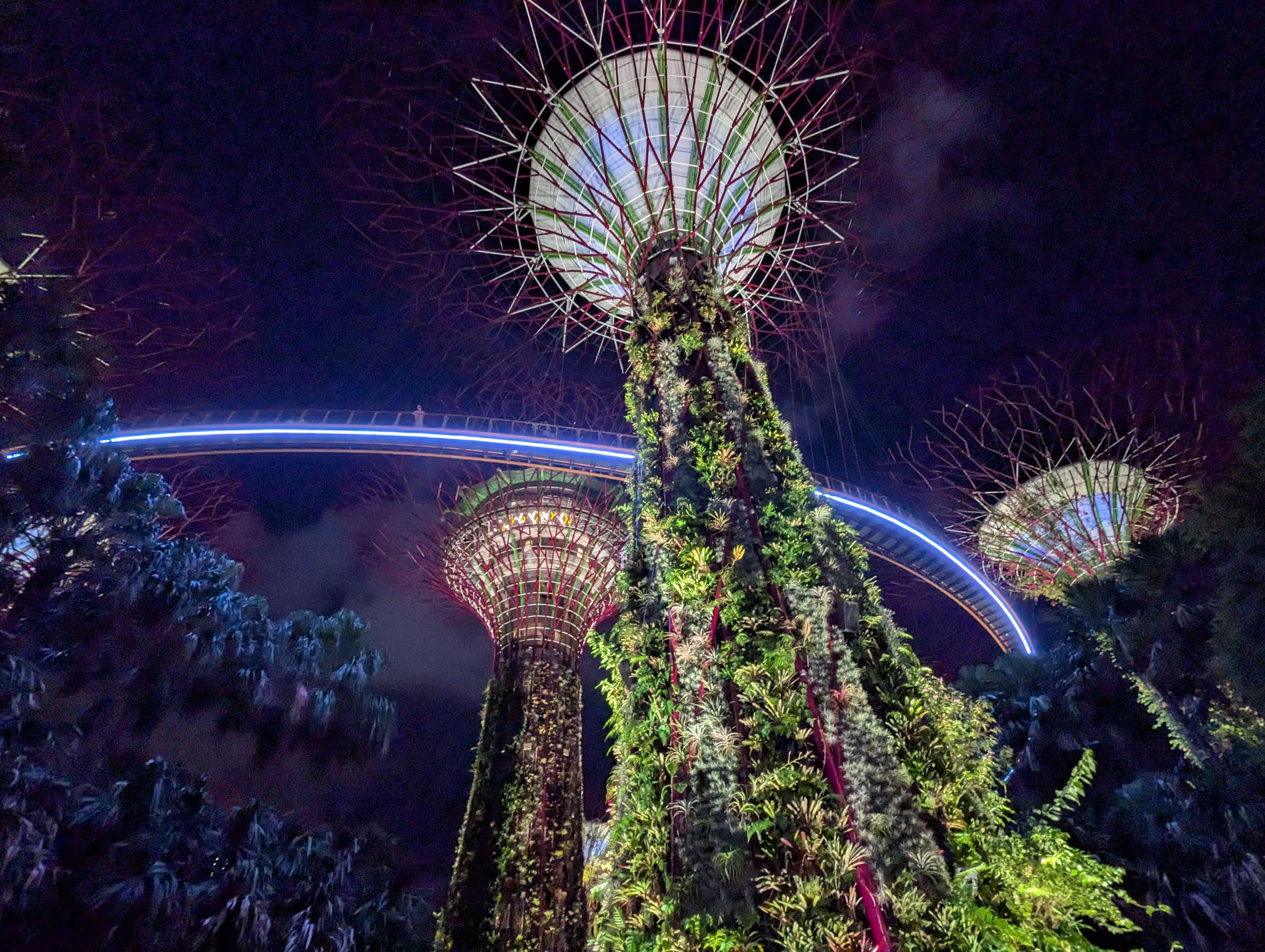
The opulence of Singapore, the futuristic glaze, is striking from the moment you enter Singapore. Changi Airport is considered the best airport in the world and it is a sight to behold. Entering the city’s downtown, you are struct by what seem like artist renders of a eco-futuristic science fiction—lush green foliage crawling up towering skyscrapers, multi-plant, tree-like super structures, a boat on top of three towers as a hotel. Juxtaposed against 4$ hawker stalls, Teochew and Hokkien bak kuh teh肉骨茶 | ròu gǔ chá | juk6 gwat1 caa4 | Hokkien: bah-kut-tê, Singapore felt like the most “modern” city I’ve ever been to.
Taiwan
臺灣 / 台灣táiwān | toi4waan1 (táiwān | toi4waan1)
I spent a month before the trip learning a bit of introductory Mandarin via SuperChinese, though my friends handled most of the interactions. Some useful phrases / words I’m glad I learned beforehand:
- 我的中文不好。(My Chinese is not good. | wǒ de zhōngwén bù hǎo.)
- 可以 (Can do | kěyǐ)
- 不可以 (Cannot do | bùkěyǐ)
- 對 (Right | duì)
- 這個 (This one | zhège)
- 一/二/三… 號 (Number # | yī / èr / sān / … hào)
- 有花生嗎? (Are there peanuts | yǒu huāshēng ma?)
- 一杯奶茶 (Milk tea | yībēi nǎichá)
- 半糖, 少冰 (half-sugar, less ice | bàn táng, shǎo bīng)
- 謝謝 (thank you | xièxiè)
The better practice I had in Taiwan was actually reading and recognising hanzi or Chinese characters. I’ve been doing vocabulary practice with Drops over the past two years or so, although in a very unrigorous way. Having to actually look at words and use context to try and guess at what characters would be was really helpful exercise and I think I got a bit better at reading text throughout the trip.
As a country, Taiwan is Mandarin speaking, although there exists a large population that still speaks Taiwanese (Taiwanese Hokkien), especially in the south of the country. Similar to other countries, Taiwan too is experiencing the decline of some of its historic spoken languages, although in this case neither of these languages are truly indigenous as these populations are recently settled onto the island.
Taiwan was probably the most immersive experience on this trip in that it was most Chinese-forward, meaning there were often times English wouldn’t get you very far.
I spent a lot less time indulging in the history of Taiwan on this trip. Maybe because I see it referenced so often in the news and its tense geopolitical situation. There’s definitely a lot more to learn with the history of Taiwan, but for this trip I’m glad to indulge in the delicious food, souvenirs, and natural beauty.
Taipei, Taiwan
臺北táiběi | toi4bak1 (táiběi | toi4bak1)
It was on this trip that I learned that the cities in Taiwan are named after their geographic locations. As you might expect, 台北táiběi | toi4bak1 is 北běi | bak1 (North) just like 北běijīng | bak1ging1京 (Beijing) is 北běi | bak1 (North).
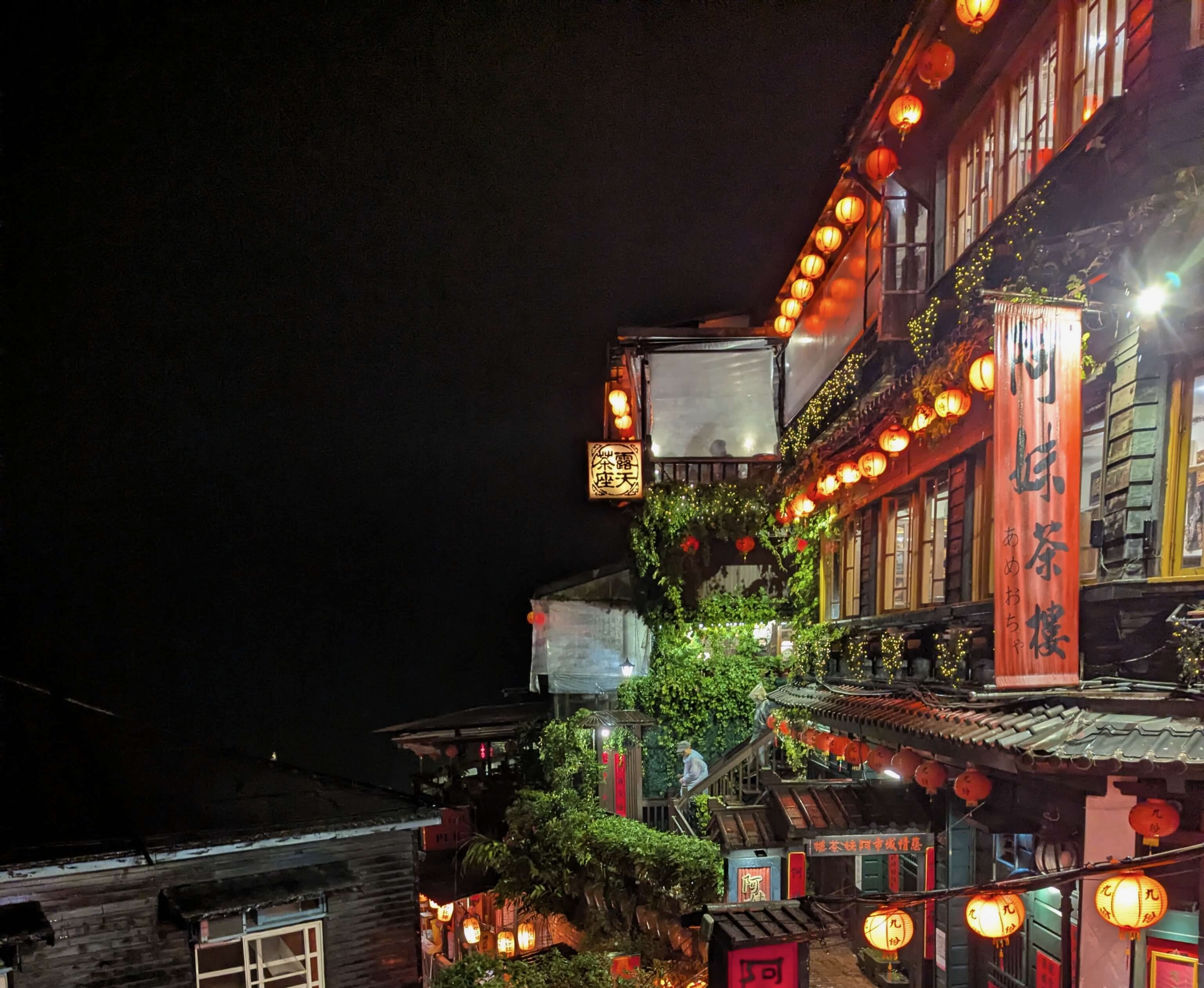
We spent the majority of our time in Taipei while in Taiwan. Overall, it was a trip mostly surrounding food and seeing some the major sights (Taipei 101, 象山 / Hsiangshanxiàngshān / zoeng6saan1 (Elephant Mountain), Chiang Kai-Shek Memorial), buying pineapple cakes, eating delicious food, and doing a day trip out to the 野柳地質公園yěliǔ dìzhí gōngyuán | je5lau5 dei6zat1 gung1jyun2 (Yehliu Geopark) / 十分shífēn | sap6fan1 (Shifen) / 九份 / Chiufenjiǔfèn | gau2 fan6 (Jiufen). Also got to stop by the Pokemon Centre in Taipei to get an exclusive plushie (we also snagged an exclusive in Singapore!).
It’s interesting to think about Taiwan as being such a young but relatively vibrant democracy, with democracy only formally around for about 30 years. Similarly, this was the first place during this trip where gay marriage has been legalised. Taiwan too felt very safe, orderly, and inviting as a tourist, very similar to Singapore.
The food highlights were:
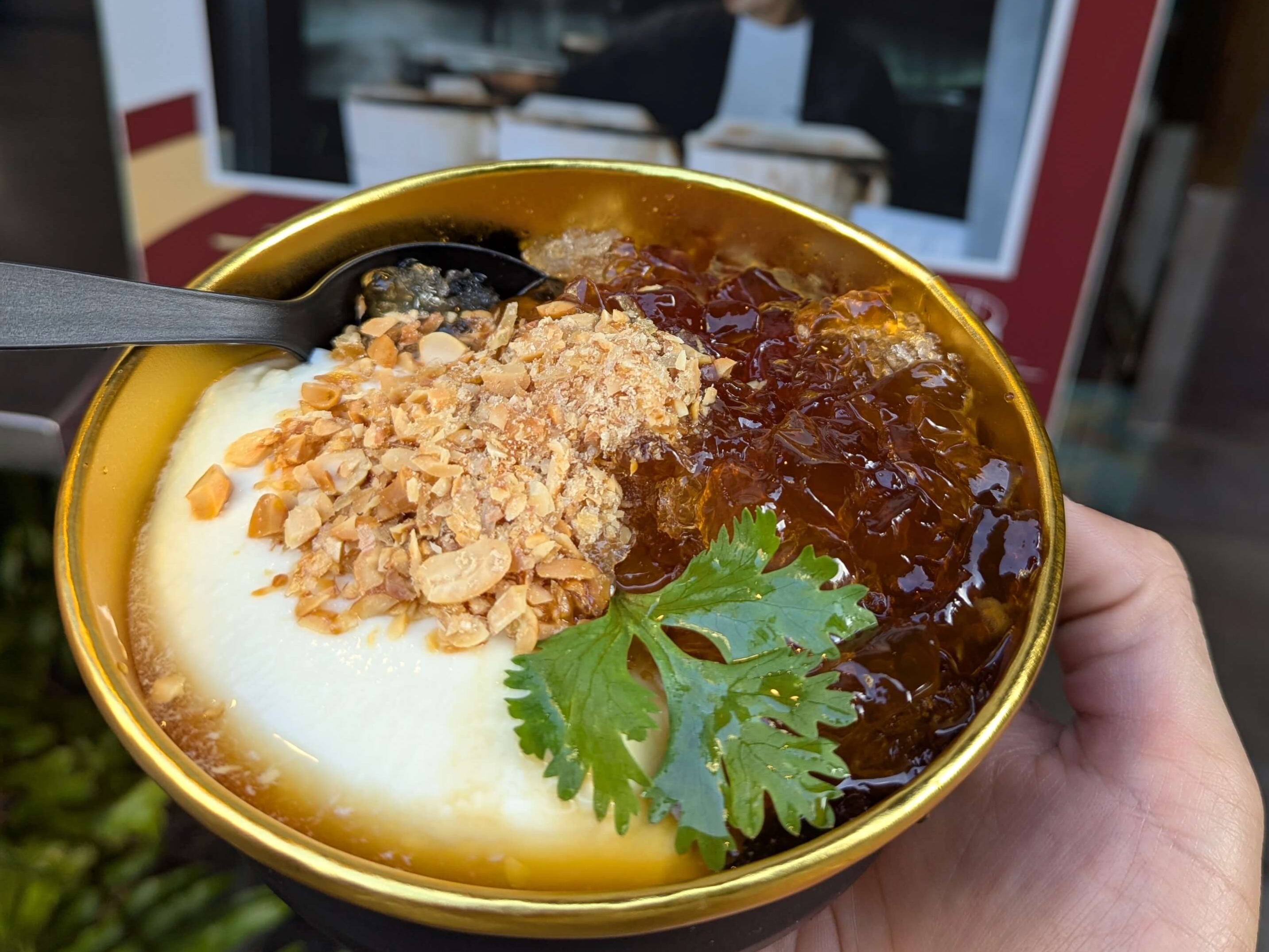
- The 豆腐花dòufu huā | dau6fu6 faa1 (tofu pudding) from 白水豆花báishuǐ dòuhuā | baak6seoi2 dau6faa1.
- The 芝麻麵zhīma miàn | zi1maa4 min6 (sesame noodles) from 雙月食品社Shuāng yuè shípǐn shè | soeng1 jyut6 sik6ban2 se5.
- The tea pairing at the 1 Michelin Star 天香樓Tiānxiāng lóu | tin1hoeng1 lau4.
Taichung, Taiwan
臺中táizhōng, toi4zung1 (táizhōng, toi4zung1)
While not quite in the middle of Taiwan, it is in between 台北táiběi | toi4bak1 and 台南táinán | toi4naam4, so 台中táizhōng, toi4zung1 would be 中zhōngjiān | zung1gaan1間 (centre). We only stopped here for a night on our way to Sun Moon Lake.
I ordered some fried mushrooms at the night market and got caught up when he asked me what flavour I wanted. A quick scan of Chinese-only menu, the only immediately recognisable characters to me were 五香wǔxiāng | ng5 zung2* hoeng1liu2* (five-spice), so that’s what I pointed to. Should really have learned how to say 原味yuánwèi | jyun4mei6 (original) earlier, but here we are.
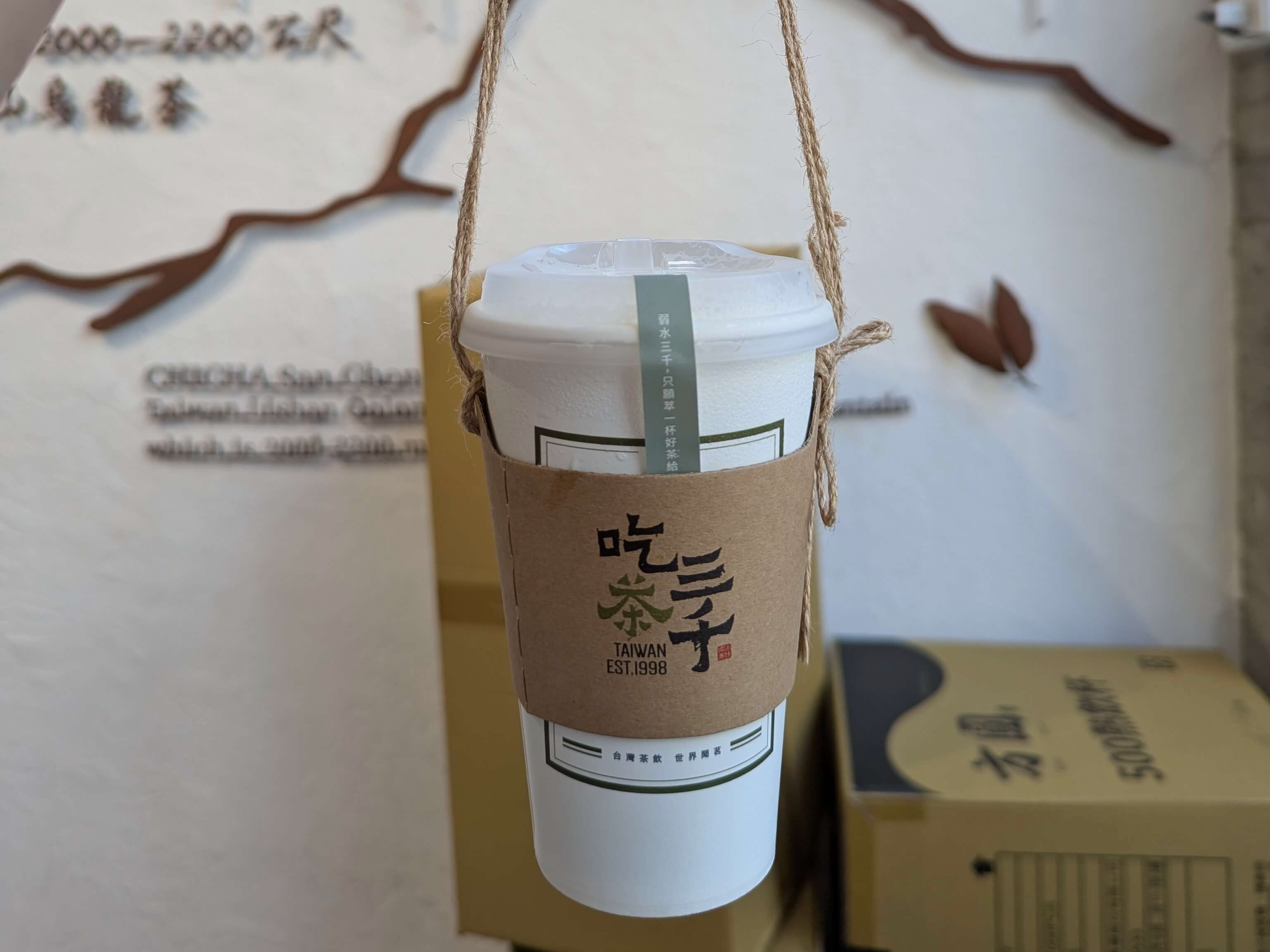
We also stopped by the flagship 吃茶三千chīchá sānqiān (Chicha) where there was a free tea tasting. The branches here in Canada are honestly pretty comparable in flavour (I do really like Chicha), but there’s no free tea tasting and there are few flavours that I hasn’t seen in Canada, so it was worth the visit.
Sun Moon Lake, Taiwan
日月潭rì yuè tán | jat6 jyut6 taam4 (rì yuè tán | jat6 jyut6 taam4)
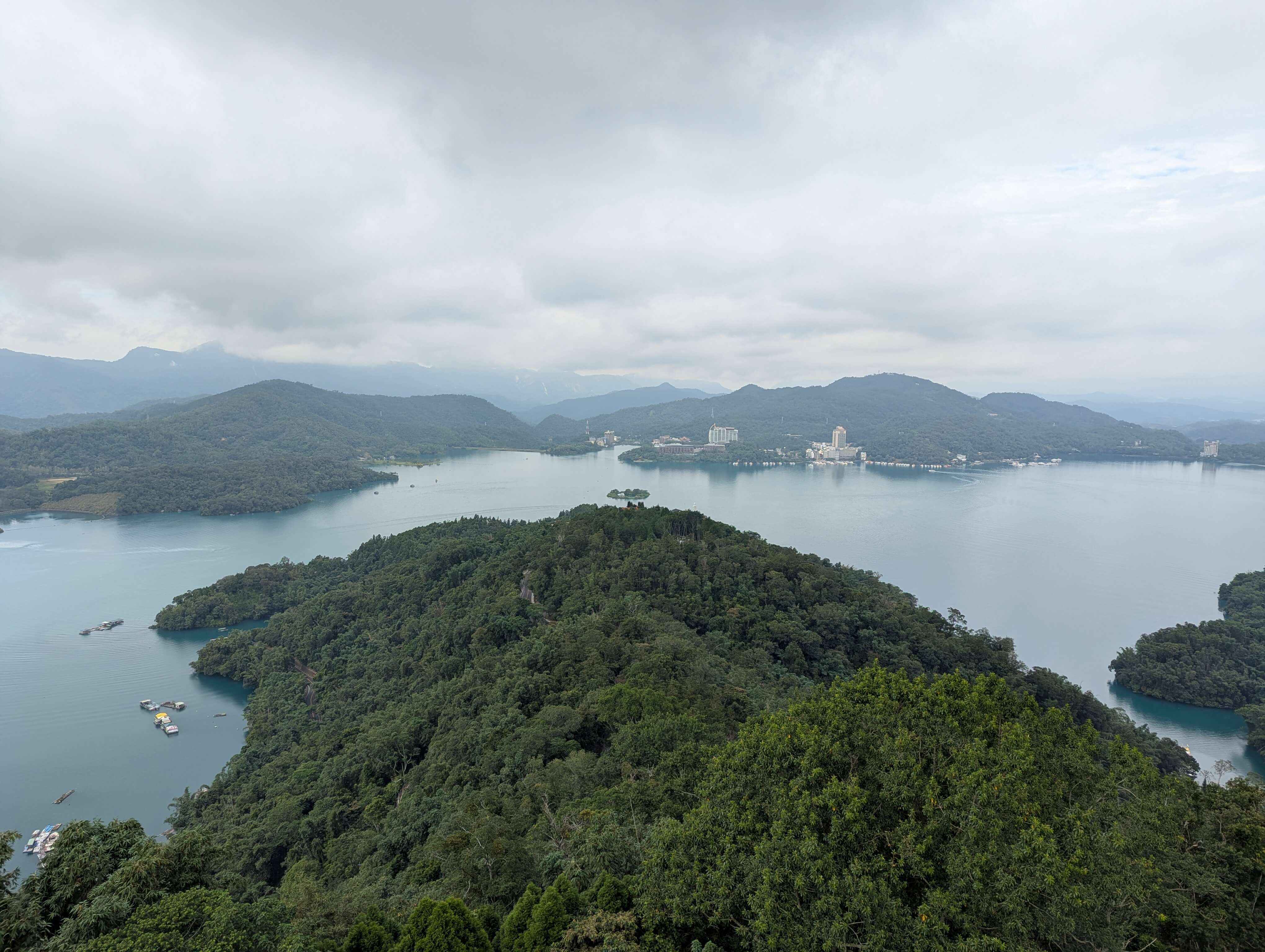
Our last major stop was Sun Moon Lake, a pretty popular tourist destination with a mountain lake surrounded by mountains on all sides. It’s a popular recreation area with temples, small settlements, viewing towers, and biking paths. After spending so much time in the cities, it was nice to get away and enjoy the lush mountainside of Taiwan.
Our tour guide to Chiufen pointed out to us that the lake in Sun Moon Lake is not a 湖hú / wu4, but a 潭tán / taam4. The distinction having to something to do with the depth the body of water, but there may have been some context lost in translation.
We biked around part of the lake, did a short hike, and climbed a viewing pagoda to get a great view of the lake. A bit rainy, but nothing too crazy and a much needed breath of fresh air to end the trip.
Our last stop on the way back was to Hohocha Tea Factory (喝喝茶hē hē chá | hot3 hot3 caa4 | 台灣香日月潭紅茶廠Táiwān xiāng rìyuètán hóngchá chǎng | toi4waan1 hoeng1jat6 jyut6taam4 hung4caa4 cong2) to pick up some souvenir 紅玉茶hóngyù chá | hung4juk6 caa4 (ruby black tea) alongside a quick tea egg snack!
Final Thoughts
Having gone back to Asia, I was really charmed. As a 加拿大華僑gaa1naa4daai6 waa4 kiu4 with 越南華僑jyut6naam4 waa4 kiu4 roots–i.e. ethnic Chinese outside of China–I’m essentially twice removed from that heritage. Without a doubt I feel Canadian first and foremost, having grown up here, but as I grow older it’s become increasingly important to me to find connections with my heritage and my roots. How did you get to be here? What was the moment?
Stay tuned, I’ll share more of that journey in some future blog posts.
Well, that’s it for now! 下次再寫haa6ci3 zoi3 se2!