Where are you from?
As a child of immigrants, the question “where are you from?” takes on many connotations depending on who is asking that question. My response also depends on how I’m feeling and what I believe the asker is really asking.
It’s the kind of question that often has very insidious connotations, a way to imply that you’re not from here, that you don’t belong. Many see it is a constant micro-aggression, a constant othering, a way to reinforce a societal hierarchy. Particularly in Canada, a country that is still very white, especially outside its metropolitan areas.
On the other hand, it’s a question I find myself asking often for others in the diaspora, for the people who find themselves home away from home. How have your roots influenced you? How did you find your way here? But it’s a question that I think is hard for me to answer because it’s hard to determine where I should begin.
Yue Language and Cantonese
粵語jyut6 jyu5 and 廣東話gwong2 dung1 waa2
The language I grew up speaking and continue to speak at home is Cantonese. Cantonese is the lingua franca of the Southern Chinese diaspora. My parents taught me to speak in Cantonese, although I was a poor student. One who asked to stop Chinese School after I was 6 to make time for video games and childhood joys. That’s a regret I still have to this day, characterised by a conversational Cantonese that is far from fluent and almost no understanding of Chinese characters 漢字hon3 zi6.
Cantonese remains a key part of how I image my roots, as many second generation language speakers feel about their own language. I made an intentional choice when I was 12 or so, in 7th grade, to speak to my parents in Cantonese, as I realised my ability to speak it was quickly atrophying. In recent year I’ve been putting in effort to try and improve upon my Cantonese (a topic I’ll cover in a future blog post!). These ties in language and culture connect me to a Chinese-Canadian identity, rooted in the historic Southern Chinese diaspora.
Hoa People / Người Hoa
唐人tong4 jan4 (*lit. Chinese People*)
But my parents were not born in China, let alone Hong Kong, the nexus of modern Cantonese. My parents are born in Saigon (Sài Gòn / Ho Chi Minh City), growing up in District 11 of Chợ Lớn / 堤岸tai4 ngon6, a largest Chinese diasporic community in Vietnam. The Hoa People, or the Vietnamese Chinese, would be the ethnic minority categorisation in Vietnam.
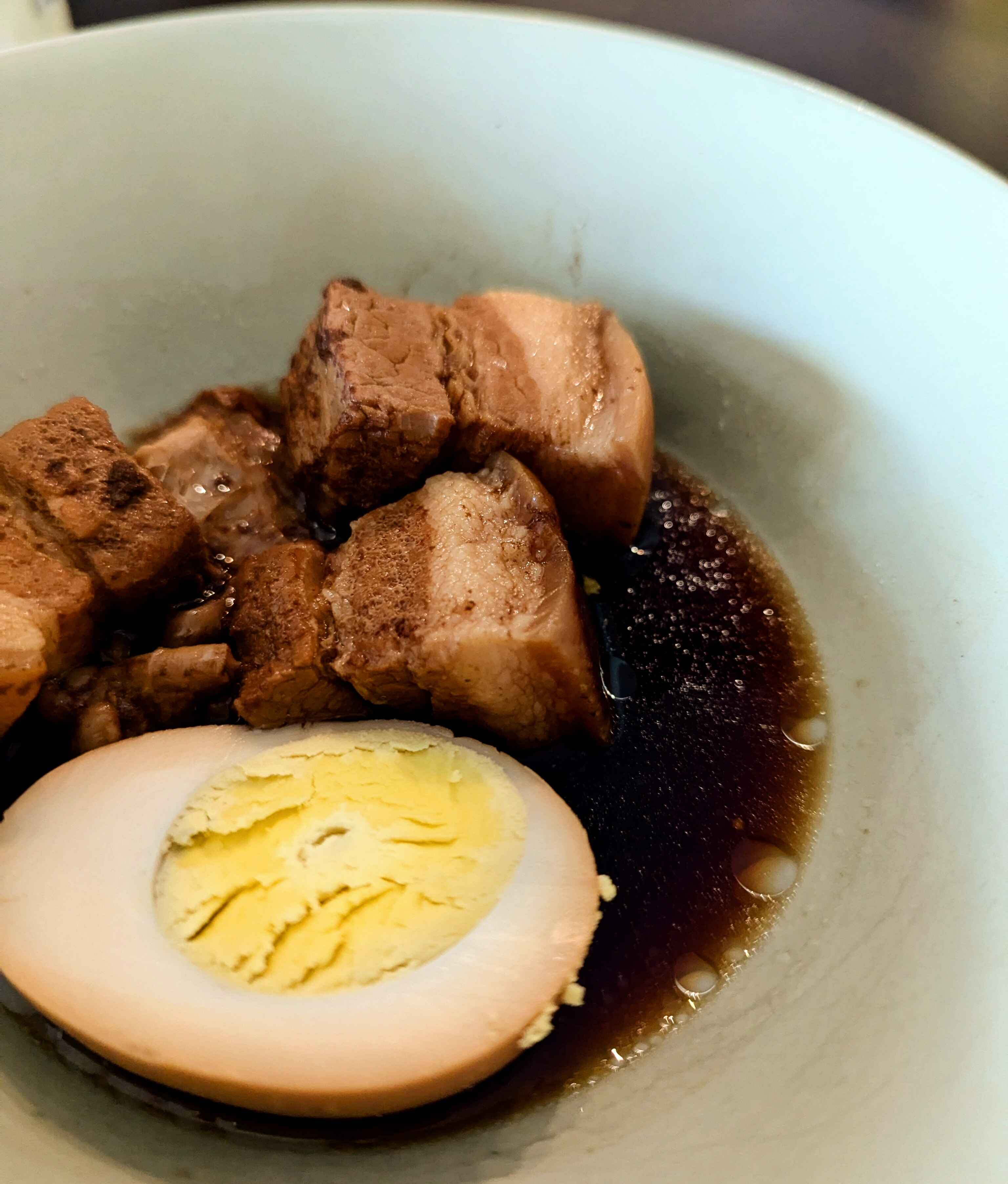
The food I grew up eating was distinctly Vietnamese—phở gà 雞粉gai1 fan2, gỏi cuốn 菜卷coi1 gyun2, chả giò 春卷ceon1 gyun2, cơm tấm 越南飯jyut6 naam4 faan6, thịt kho 炆蛋man1 daan2, chảtranscription: zaa5, nem nướng/肉transcription: nem3 juk6.
All of this shapes a sense of Chinese-Vietnamese heritage, though I would struggle to describe myself as Vietnamese. I know a surprising number of people who fall into this category, with parents either born or grown up in Vietnam, and having now migrated to Canada. This heritage leaves its own marks, and it can be hard to situate those specific quirks in pronunciation and culture, and to decide whether they’re important to preserve.
Teochew People
潮州人ciu4 zau1 jan4
If I think of myself as Chinese once-removed, I would consider myself Teochew twice-removed. If there is a language barrier when I speak with my parents, there’s a language canyon between my and my grandparents. I am Teochew, in the sense that is where my families, traced back far enough, once came from. It feels like only the vestiges of the language remain in my family, the a-mah and a-gong I use to refer to my grandparents, the bek , diur, and gu for my uncles, the gim, mm, and yi for my aunts. I don’t know what it means to be Teochew, though I’d like to find out more.
The Project
I’ve been exploring varying aspects of reconnecting with these different parts of my identity and roots over the past few years, but I haven’t kept very good records of the process. So this is the project, documenting the myriad ways I’ve been learning about what it means to Cantonese-speaking, Chinese, Chinese-Vietnamese, and Teochew. I hope you’ll join me on this journey and if you’d like to get in touch, feel free to shoot me a message wherever you can find me. Until next time! 下次再寫haa6ci3 zoi3 se2!